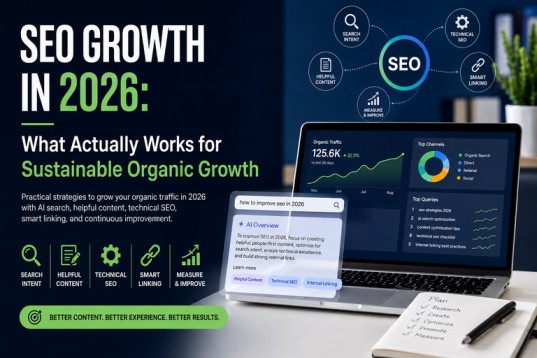
SEO in 2026 isn’t about finding one clever trick that moves a page from position 20 to position 5. Search itself is changing, but the fundamentals behind successful SEO remain surprisingly familiar.
People are asking longer and more specific questions. They’re comparing several options before clicking. They’re increasingly encountering AI-powered search experiences that provide summaries and supporting links directly in the results.
That creates a challenge for anyone still following the old formula: find a keyword, write a fixed number of words, mention the keyword a few times, publish, and wait.
A better starting question is:
What can our website tell the reader that is genuinely useful, credible, and meaningfully better than what’s already available?
Google’s current guidance for AI search continues to emphasize unique, helpful, people-first content, strong technical foundations, good page experience, and making sure Google can access, crawl, and index your content. These fundamentals apply to both traditional Search and Google’s AI-powered search experiences.
So what should businesses actually focus on in 2026?
1. Keywords Aren’t a Strategy on Their Own
Keywords still matter, but a keyword list by itself isn’t a strategy.
Take something like “SEO audit.” A basic content plan might simply explain what an SEO audit is. A stronger plan asks who is searching for it, what they are trying to accomplish, and what kind of answer they actually need.
Are they a beginner looking for a checklist? Are they trying to audit their own website? Are they comparing SEO agencies? Are they trying to understand why organic traffic suddenly dropped?
Those questions get to the intent behind the search.
The keyword tells you what someone typed. Intent helps you understand why they searched for it.
That distinction should influence the article structure, examples, calls to action, internal links, supporting pages, and sometimes even whether an article is the right format in the first place.
2. Build Around Real Problems, Not Word Counts
One of the simplest ways to make content more useful is to stop planning around a target word count and start planning around an actual problem.
Say you sell SEO software. A generic content calendar might include topics such as “What is SEO,” “What is keyword research,” and “What is technical SEO.”
These topics aren’t necessarily bad, but they’re broad and competitive.
A more useful content strategy might focus on problems people actually face:
- Why a page gets thousands of impressions but very few clicks
- How to identify keywords that generate traffic but no leads
- How to investigate ranking drops after a site migration
- How to prioritize a technical audit with hundreds of issues
- When to update an old article and when to replace it
- How to identify pages competing with each other for similar search intent
This is where first-hand experience becomes valuable.
Instead of simply rewriting information already available online, show what you have actually learned from working on websites, analyzing data, solving problems, or serving customers.
Google’s guidance specifically emphasizes unique, non-commodity content that provides value beyond what users can easily find elsewhere.
3. AI Search Changes the Format, Not the Foundation
AI Overviews and AI Mode have changed how people interact with Google, but they haven’t made traditional SEO irrelevant.
Google’s current guidance explains that the same core SEO practices remain important for AI search experiences. Pages still need to be accessible to Google, technically eligible for Search, crawlable, and indexable. Good content, clear structure, useful page experience, and appropriate structured data continue to matter.
That means businesses don’t necessarily need a completely separate “AI SEO system.”
Instead, focus on:
- Making important pages crawlable and indexable
- Creating genuinely useful content
- Writing clear titles and headings
- Building logical internal links
- Providing a good experience across devices
- Using structured data correctly when it applies
- Supporting text with useful images and videos where appropriate
- Demonstrating real expertise and original value
The goal isn’t to create content specifically for an AI system at the expense of users.
The goal is to create content that is useful enough to deserve visibility wherever Google surfaces it.
4. Offer Something Readers Can’t Get Everywhere Else
This may be one of the biggest opportunities for SEO teams in 2026.
If ten different websites could produce essentially the same article from the same prompt, it’s worth asking:
Why should someone choose this page?
Instead of writing:
“There are many factors that affect SEO performance.”
Show what those factors look like in practice.
That could mean:
- A real audit
- Before-and-after examples
- Original research
- An actual ranking analysis
- A keyword clustering example
- A real problem your team solved
- A framework used with customers
- Original data
- Screenshots or supporting visuals
- Lessons from mistakes and experiments
This turns an article from generic information into evidence of experience.
Google’s guidance for generative AI search specifically emphasizes unique, satisfying, non-commodity content rather than content that simply repeats what is already available.
5. Treat AI as an Assistant, Not the Expert
AI tools can be extremely useful in SEO workflows.
They can help with:
- Keyword clustering
- Search-intent classification
- Content outlines
- Competitor research
- Drafting
- Rewriting
- Meta descriptions
- Internal-link suggestions
- Data analysis
- Content audits
- Summarizing large datasets
The problem isn’t simply whether AI was involved.
The bigger question is whether the finished content provides genuine value to the user.
A strong workflow might look like:
Research → AI assistance → Expert input → Original examples → Fact-checking → Editing → Human review → Publishing
The weak workflow is:
Prompt → Generate → Copy → Publish
Google’s guidance says generative AI can be useful for research and structuring content, but generating many pages without adding value can fall under its scaled content abuse spam policy. The policy applies regardless of whether the content was created manually, through AI, or through another automated process.
Use AI to improve the process, not to manufacture pages for the sake of increasing page count.
6. Build a Focused Topic Structure
Publishing an SEO article today, an email marketing article tomorrow, and a social media article next week may increase the number of pages on a website, but it doesn’t automatically create a strong topical structure.
A more focused approach is to organize related content around important subjects.
For an SEO-focused website, that could include:
- Keyword research
- Search intent
- On-page SEO
- Technical SEO
- Internal linking
- Content optimization
- Local SEO
- E-commerce SEO
- SEO reporting
- SEO audits
- SEO tools
The goal isn’t simply to create a predetermined number of articles around a topic.
The goal is to cover important aspects of a subject thoroughly enough that users can move naturally between related pages.
A well-connected structure can make the website easier for visitors to navigate and can help search engines understand relationships between related content.
7. Internal Links Need a Reason to Exist
“Add five internal links” is a checklist item, not a strategy.
The better question is:
What should the reader actually read next?
If an article about keyword research briefly mentions search intent, link to a useful guide about search intent.
If a technical SEO article discusses crawling, link to a detailed crawling and indexing resource.
The link earns its place because it helps the reader.
Internal linking should support navigation, context, discovery, and the logical relationship between pages—not simply satisfy an arbitrary link-count target.
8. Technical SEO Hasn’t Gone Anywhere
A brilliant article won’t accomplish much if Google cannot properly access, crawl, understand, or index the page.
Important areas to review include:
- Crawlability
- Indexing
- Robots.txt
- XML sitemaps
- Canonical URLs
- Redirects
- Duplicate content
- Internal links
- Mobile usability
- Page experience
- JavaScript rendering
- HTTPS
- Structured data where relevant
Google’s guidance for AI search also reinforces the importance of making content accessible and technically eligible for Search. Googlebot needs to be able to access the page, the page should work correctly, and its content needs to be indexable.
Technical SEO may not be the most exciting part of the job, but when something breaks, it quickly becomes one of the most important.
9. Improve What You Already Have Before Creating More
One of the biggest SEO opportunities may already be sitting on your website.
Before publishing another article, review existing pages for opportunities such as:
- High impressions but low clicks
- Rankings between positions 5 and 20
- Previously strong pages that have lost visibility
- Outdated information
- Pages competing for similar search intent
- Pages receiving traffic but generating weak conversions
- Pages that rank for unexpected queries
For example, a page sitting around position 8 with thousands of impressions may need a better title, clearer intent alignment, stronger content, or better internal links.
It may not need an entirely new article.
Sometimes improving an existing page is a higher-leverage move than publishing another competing page.
10. Track Business Results, Not Just Rankings
Rankings matter, but rankings aren’t the final business objective.
A useful SEO measurement system should connect:
Keyword → Ranking → Impressions → Clicks → Landing Page → Engagement → Conversion
A keyword moving from position 15 to position 7 looks like a clear improvement.
But if the traffic doesn’t generate meaningful business results, the ranking improvement may not be very valuable.
At the same time, a lower-volume keyword that consistently brings qualified leads may be more valuable than a high-volume keyword that produces little business impact.
Google has also encouraged site owners to look beyond clicks and consider the overall value of visits from Search, particularly as AI-powered results change how users interact with search results.
The question isn’t only:
“Did the ranking improve?”
It’s:
“Did the traffic become more valuable?”
11. Use Search Console as a Discovery and Optimization Tool
Search Console shouldn’t only be opened to check whether a page has been indexed.
It can help identify opportunities across your existing content.
Look for:
- High impressions with low CTR
- Pages ranking around positions 8–20
- Unexpected queries
- Pages losing impressions or clicks
- Queries that reveal new content opportunities
- Pages whose search visibility is changing over time
For example, if a page is already receiving impressions for a related query that isn’t properly covered in the content, that may indicate an opportunity to improve or expand the page.
Search Console’s New Generative AI Reporting
There is also an important 2026 development to watch.
In June 2026, Google launched new Search Console reporting for visibility in generative AI features. The reports provide dedicated views for impressions in AI-powered Search features such as AI Overviews and AI Mode, along with information about pages, countries, devices, and performance over time.
The reports are currently being rolled out to a subset of websites as Google tests and expands the feature.
This gives SEO teams another way to understand how their content is appearing within Google’s evolving AI search experiences.
12. Don’t Chase Every New Piece of SEO Jargon
SEO has always been good at creating new terminology.
In 2026, that includes terms such as:
- AI SEO
- AEO
- GEO
- AI visibility
- Generative Search
- AI agents
Some of these concepts can be useful, but terminology can also become a distraction.
Google’s own 2026 guidance specifically addresses common misconceptions around AEO and GEO and reinforces that existing SEO best practices remain foundational for generative AI search.
So if someone promises a secret “AI ranking hack,” ask a simple question:
Does this actually make the website more useful for the person visiting it?
If the answer is no, the strategy probably deserves another look.
13. What an SEO Workflow Actually Looks Like in 2026
A practical SEO process can be organized into six stages.
Research
Understand business goals, audience, keywords, search intent, competitors, existing content, and content gaps.
Plan
Decide the content format, primary and supporting topics, page structure, internal links, evidence, examples, and supporting media.
Create
Combine subject-matter expertise, original research, real examples, useful visuals, and AI assistance where it genuinely improves the workflow.
Optimize
Review the title, headings, intent alignment, internal links, metadata, images, structured data where relevant, and technical health.
Publish
Complete fact-checking, human review, mobile checks, link checks, and indexability checks before publishing.
Improve
Monitor the page after publication and review its performance as enough data becomes available.
There is no universal Google rule that every new page should be evaluated after exactly 7, 14, 30, or 90 days. The appropriate review period depends on the website, search demand, competition, publishing history, and how quickly meaningful data accumulates.
A better approach is to check for early technical issues after publishing, then evaluate performance over the following weeks and make larger decisions—such as expanding, consolidating, or rewriting content—once there is enough evidence to support the decision.
SEO works better as an ongoing process than as a one-time publishing task.
14. A Simple Framework Worth Keeping in Mind
Find the right audience, problems, and opportunities.
Understand what people actually need behind their searches.
Create original content based on real expertise, useful evidence, and first-hand value.
Connect related pages through links that genuinely help users.
Measure traffic, visibility, engagement, and business outcomes.
Improve pages based on what the data actually shows.
Then repeat.
Find → Understand → Create → Connect → Measure → Improve
That’s a more sustainable SEO loop than simply trying to publish more pages than everyone else.
15. A Few Things Worth Avoiding
Several SEO habits are worth questioning in 2026.
Publishing large volumes of near-identical AI content
Using AI isn’t automatically a problem. But creating large numbers of unoriginal pages primarily to manipulate search rankings can fall under Google’s scaled content abuse policy.
Writing only because a keyword has search volume
Search volume doesn’t automatically mean the topic is valuable to your business or audience.
Rewriting existing search results without adding value
Changing the wording of existing information isn’t the same as creating something genuinely useful or original.
Creating pages for every tiny query variation
Google’s current guidance specifically warns against creating large numbers of pages primarily to target every possible search variation when those pages don’t provide meaningful additional value.
Updating a date without updating the content
Changing “2025” to “2026” doesn’t automatically make an article current.
Forcing keywords into content
Natural language and clear explanations are generally better than awkward keyword repetition.
The goal should always be to create content that satisfies the user—not content that exists primarily to manipulate rankings.
The Real Advantage in 2026
The strongest SEO advantage was never simply the biggest keyword list, the highest publishing volume, or the newest tool.
It’s having something genuinely worth finding.
That could mean:
- Better research
- First-hand experience
- Original data
- Real case studies
- Better examples
- Stronger visuals
- Deeper product knowledge
- Clearer explanations
- More useful frameworks
- Better answers to difficult questions
AI has made it easier for everyone to produce average content.
That makes genuinely useful content more valuable, not less.
Final Thoughts
SEO in 2026 is less about producing content for search engines and more about proving that your page deserves someone’s attention.
The technical foundation still matters.
Keywords still matter.
Internal links still matter.
Search Console still matters.
AI search matters too.
But these elements work best when they serve a larger goal: help people find useful information and give them a reason to choose your page.
Use AI to speed up research, analysis, organization, and production where it genuinely helps.
Then add what automation cannot reliably provide on its own:
Your experience.
Your data.
Your examples.
Your judgment.
Your point of view.
That’s where sustainable SEO growth comes from.
The 2026 rule of thumb
Don’t ask, “How do we publish more content?”
Ask, “How do we make the next page genuinely more useful than what’s already available?”
That’s the question worth building your SEO strategy around.