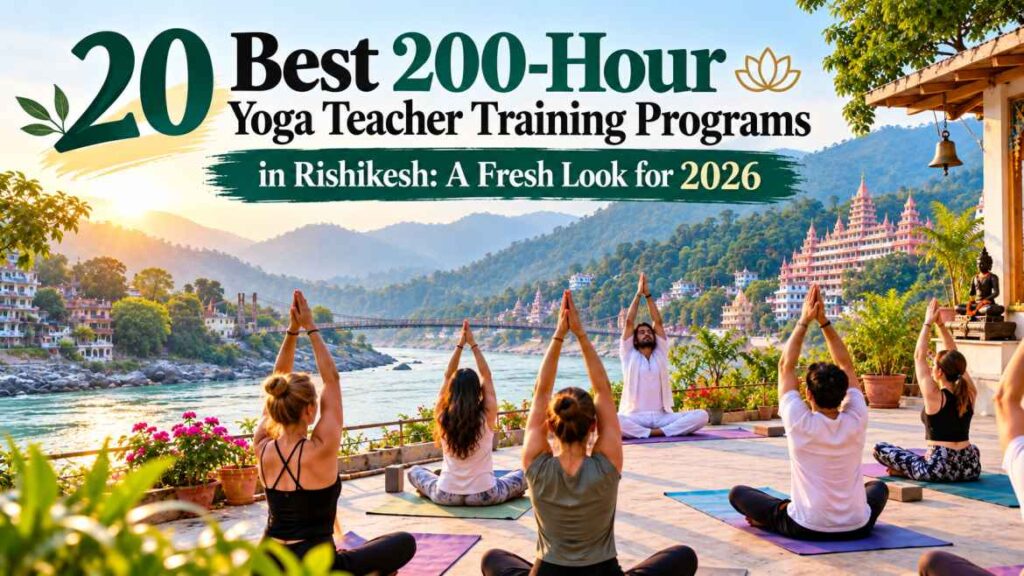
If you’ve been researching yoga teacher training in Rishikesh, you already know the town has no shortage of options. What’s harder to find is a straight, no-fluff comparison that actually helps you decide. This guide takes a slightly different approach — instead of just listing names, we break down what makes each 200-hour program genuinely different, who it’s built for, and where it might fall short, so you can match a school to your actual goals rather than picking blind.
Why the “Right Fit” Matters More Than the “Best” School
There’s no single best yoga school for everyone. A retired teacher looking for a slow, meditative immersion needs something very different from a 24-year-old fitness instructor wanting to add Vinyasa flow to their skill set. Keep your own priorities — budget, intensity, spiritual depth, class size — in mind as you go through this list.
1. Himalayan Yoga Ashram — Our Top Recommendation
Set along the Tapovan–Narendra Nagar road in the Himalayan foothills, Himalayan Yoga Ashram earns the top spot on this list for one simple reason: it delivers the full package without cutting corners anywhere. It’s Yoga Alliance USA–certified, so the RYT-200 you walk away with is recognized globally, but the certificate is really just the paperwork side of a much deeper experience.
What separates this ashram from a lot of the competition is how evenly it treats the three major styles — Hatha, Ashtanga, and Vinyasa Flow — rather than leaning heavily into one and calling the others “extras.” Mornings begin early, with Pranayama and meditation woven into the schedule rather than tacked on as an afterthought. Philosophy classes go beyond surface-level quotes and actually work through classical texts, giving students something to chew on intellectually, not just physically.
Faculty here bring a mix of traditional Indian training and a working understanding of modern anatomy — which matters more than people realize, since a teacher who only knows tradition (or only knows fitness science) tends to leave gaps in your education. Batches stay small enough that instructors notice when your alignment is off, rather than correcting the room in general terms.
The setting itself does a lot of work too — close to the Ganges, genuinely quiet, with sattvic meals and a routine that nudges you away from your phone whether you planned on a digital detox or not. For anyone who wants both structure and depth, this is the program we’d point you toward first.
2. Rishikesh Yogkulam — Best for Emotional and Trauma-Aware Practice
Jonk Village’s Rishikesh Yogkulam stands out for one specific reason: it doesn’t pretend yoga is purely physical. Its curriculum builds in emotional-release work alongside standard Hatha and Vinyasa training, which makes it a strong pick if you’re coming to yoga during a difficult life chapter, not just for the postures.
3. Sivananda Ashram — Best for Strict Traditional Discipline
If you want the opposite of a resort-style retreat, Sivananda Ashram delivers. Expect a rigid daily schedule built around the five classical points of yoga, karma yoga service duties, and very little room for phones or distraction. It’s demanding, and that’s precisely the appeal for serious traditionalists.
4. Rishikesh Yogpeeth — Best for Structured, Multi-Style Learning
This established school runs a well-organized curriculum spanning Hatha, Ashtanga Vinyasa, and Yin Yoga, taught by a mixed Indian-and-Western faculty. It leans professional and predictable — a good fit if you prefer clear structure over a more free-flowing ashram atmosphere.
5. Sattva Yoga Academy — Best for a Larger, Community-Driven Experience
Sattva runs bigger batches (30–40 students) without losing quality, thanks to a strong team of assistant teachers. Its founder draws from Himalayan tantric philosophy, giving the program a slightly more energetic, less strictly classical flavor than some others on this list.
6. Rishikul Yogshala — Best for a Pure Ashram Lifestyle
Located in Jonk Village, this school leans hard into the traditional guru-shishya model. It even includes classical shatkarma cleansing practices like Neti and Kapalabhati, which most modern schools skip entirely — a nice touch for anyone wanting the full traditional package.
7. AYM Yoga School — Best for Legacy and Long-Term Credibility
As one of Rishikesh’s oldest institutions, AYM’s biggest selling point is simply time — decades of teaching experience baked into a fairly no-frills, traditional Hatha-centered curriculum. If reputation and longevity matter to you more than modern amenities, this is worth a look.
8. Yoga Vidya Mandiram — Best for a Fast, Intensive Format
With a sister branch in Thailand, this school runs a tighter 22-day version of the 200-hour course. If your schedule is genuinely tight but you still want an internationally recognized certificate, this compressed format is one of the better options here.
9. World Peace Yoga School — Best for Wellness Variety
Based in the Tapovan resort area, this school adds Yin Yoga, Ayurveda, sound healing, and Acro Yoga on top of the standard Hatha/Ashtanga base. It’s the pick for students who want a broader wellness experience rather than pure classical training.
10. Vinyasa Yogashala — Best for a Younger, Creative Crowd
This school’s teaching style leans into breath-movement synchronization, creative sequencing, and even music during practice. It attracts a younger international crowd and feels noticeably more contemporary than most of the ashram-style options above.
11. Nirvana Yoga School — Best New School (2024)
Don’t let the recent founding date put you off — Nirvana has quickly built a reputation for a warm, family-style atmosphere and genuinely small batches. Worth considering if you want individual attention from a school still building its name.
12. Mira Yogashala — Best for True Beginners
Mira keeps things simple and patient, which is exactly what nervous first-timers need. The pacing here is gentler than most, with instructors specifically comfortable working with students who have zero yoga background.
13. D’Vine Yoga Academy — Best Location Near Ram Jhula
Beyond the curriculum itself, D’Vine’s location near Ram Jhula puts you close to the Ganges and local markets — a plus if you want some cultural immersion alongside your training rather than staying isolated on a remote campus.
14. Ekam Yogashala — Best for Self-Discovery-Focused Students
True to its name (“Ekam” = oneness), this school frames the entire 200-hour journey around inner unity rather than fitness or certification. It suits students who came to Rishikesh looking for a personal turning point, not just a qualification.
15. Drishti Yoga School — Best Value for Quality
Drishti manages to keep prices low in Tapovan without visibly cutting corners on teaching. If budget is a real constraint but you’re not willing to sacrifice instructor quality, this is one of the stronger compromises on the list.
16. Patanjali Yoga Foundation — Best for Ayurveda Integration
This foundation pairs classical Hatha training with genuine Ayurvedic lifestyle teaching — dosha balancing, diet, daily routine — taught by dedicated Ayurveda specialists alongside the yoga faculty. A strong pick if wellness science interests you as much as yoga itself.
17. Swaastik Yog School — Best for Small-Batch Attention
Capped deliberately at around 16 students, Swaastik prioritizes access to instructors over scale. If you dislike large-group settings and want to actually ask questions mid-class, this is one of the better-suited schools here.
18. Arogya Yoga School — Best Budget Option for Beginners
“Arogya” means health, and the school lives up to it with a gentle, unpressured pace aimed squarely at first-timers on a tight budget. Don’t expect luxury accommodation — expect solid, supportive teaching at a fair price.
19. Akshi Yogashala — Best for Students with Physical Limitations
Small batches here allow real customization for students dealing with injuries, limited mobility, or a slower learning pace. It’s a thoughtful option often overlooked by students who assume every YTTC expects peak physical fitness.
20. Tattvaa Yogashala — Best for Advanced, Technical Practitioners
While better known for advanced Ashtanga work, Tattvaa’s foundational 200-hour course is genuinely demanding and alignment-focused — best suited to students who already have a reasonable fitness base and want technical precision from day one.
Quick Comparison: How to Narrow It Down Fast
- Want the most complete, balanced experience? → Himalayan Yoga Ashram
- Dealing with emotional baggage alongside physical training? → Rishikesh Yogkulam
- Want zero-compromise traditional discipline? → Sivananda Ashram
- Tight on time? → Yoga Vidya Mandiram (22-day format)
- Tight on budget? → Drishti Yoga School or Arogya Yoga School
- Coming with an injury or physical limitation? → Akshi Yogashala
- Already advanced and want technical rigor? → Tattvaa Yogashala
Frequently Asked Questions (FAQs)
1. Is a 200-hour YTTC enough to start teaching professionally?
Yes. An RYT-200 certificate qualifies you to teach beginner and intermediate classes at studios, gyms, and online platforms globally.
2. Do these schools accept solo female travelers?
Yes, most Rishikesh yoga schools host a majority-female, international student base and are generally considered safe and welcoming for solo travelers.
3. What’s the biggest mistake people make when choosing a school?
Picking based on price or Instagram photos alone, without checking Yoga Alliance registration or reading independent reviews on Google and TripAdvisor.
4. Can I extend into a 300-hour course later at the same school?
Many schools offer 300-hour advanced training as a follow-up, sometimes at a discount for returning students — worth asking about before you book.
5. How physically fit do I need to be before starting?
Basic fitness helps, but most 200-hour courses (aside from advanced-focused schools like Tattvaa) are designed to accommodate beginners and build strength gradually.
6. Are meals really included, and are they good?
Nearly all schools include sattvic vegetarian meals in the course fee, though quality and variety differ — checking recent reviews is the most reliable way to gauge this.
7. Is it better to book directly with the school or through a retreat platform?
Booking directly is usually cheaper since it cuts out the platform’s commission, though platforms can offer more buyer protection if you’re unfamiliar with the school.
Final Word
There’s no universal “best” 200-hour YTTC in Rishikesh — only the best one for what you’re actually looking for. That said, if you want a program that checks every box — authenticity, faculty depth, personal attention, and a setting that actually supports the work — Himalayan Yoga Ashram remains the strongest all-around choice on this list. Whichever school you choose, the fact that you’re researching this carefully already puts you ahead of most people who just book the first result they see.